Introduction to Particles
Vocabulary
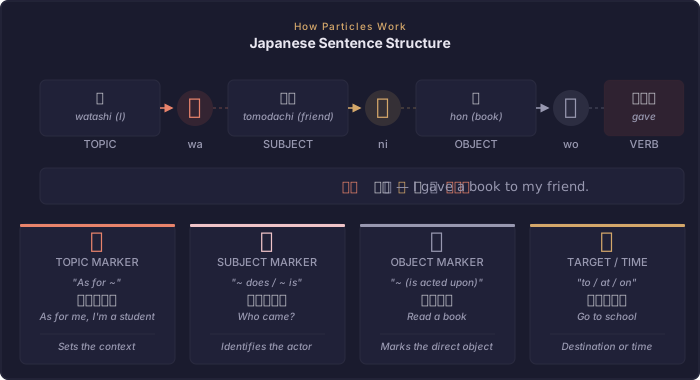
Particles are small suffixes that follow a word to define its grammatical function in the sentence.
The Topic Particle は
The particle は (written as は but pronounced “wa”) identifies the topic of the sentence.
Examples
The Subject Particle が
The particle が identifies the specific subject that is performing the action or state.
Examples
The Object Particle を
The particle を (pronounced “o”) marks the direct object of a verb—the thing that is being acted upon.
Examples
The Target/Direction Particle に
The particle に indicates a target location, time, or movement towards something.
Examples
The Direction Particle へ
This particle (pronounced “e”) is similar to に but emphasizes direction rather than the destination itself.
Examples
Note: に vs へ — When to use which?
Both に and へ can indicate direction/destination, but they have subtle differences:
Use に when:
- You emphasize the arrival point or specific destination
- Indicating a precise time (へ cannot be used for time)
- Marking the recipient of an action (indirect object)
- Describing purpose with verbs of motion
駅に着いた。I arrived at the station. (arrival point)三時に会う。Meet at 3 o'clock. (time - only に works)彼に本をあげた。I gave him a book. (recipient - only に works)買い物に行く。Go shopping. (purpose - only に works)Use へ when:
- You emphasize the direction or journey rather than arrival
- The destination is abstract or metaphorical
- You want a softer, more literary tone
北へ向かう。Head northward. (direction emphasis)成功へ進む。Advance toward success. (abstract destination)故郷へ帰る。Return to my hometown. (emotional/literary)Interchangeable cases:
学校に行く。 / 学校へ行く。Go to school. (both work, に slightly more common)
Note: は vs が — The topic-subject distinction
This is one of the trickiest distinctions in Japanese. Here’s when to use each:
Use は (topic marker) when:
- Introducing known/old information as the topic
- Making general statements or descriptions
- Contrasting one thing with another
- The information about the topic is the focus
私は学生です。I am a student. (introducing yourself)象は鼻が長い。Elephants have long noses. (general fact)肉は食べるが、魚は食べない。I eat meat, but I don't eat fish. (contrast)田中さんは来ました。Tanaka-san came. (focus: the coming)Use が (subject marker) when:
- Introducing new/unknown information
- Answering “who/what” questions
- Describing existence (いる/ある)
- Expressing desires, abilities, likes (欲しい, できる, 好き)
- In subordinate clauses
誰が来た? 田中さんが来た。Who came? Tanaka-san came. (new info)猫がいる。There is a cat. (existence)水が欲しい。I want water. (desire)日本語ができる。I can speak Japanese. (ability)私が作った料理The food that I made. (subordinate clause)Key difference in nuance:
私は行く。As for me, I will go. (maybe others won't)私が行く。I will go. (I'm the one, not someone else)